
Skip to main content
All Teardowns

The Payoff Concept Teardown

The Map That Doesn't Exist

Why $6.4 Billion Disappears Into the Ground Every Year
July 29, 2026
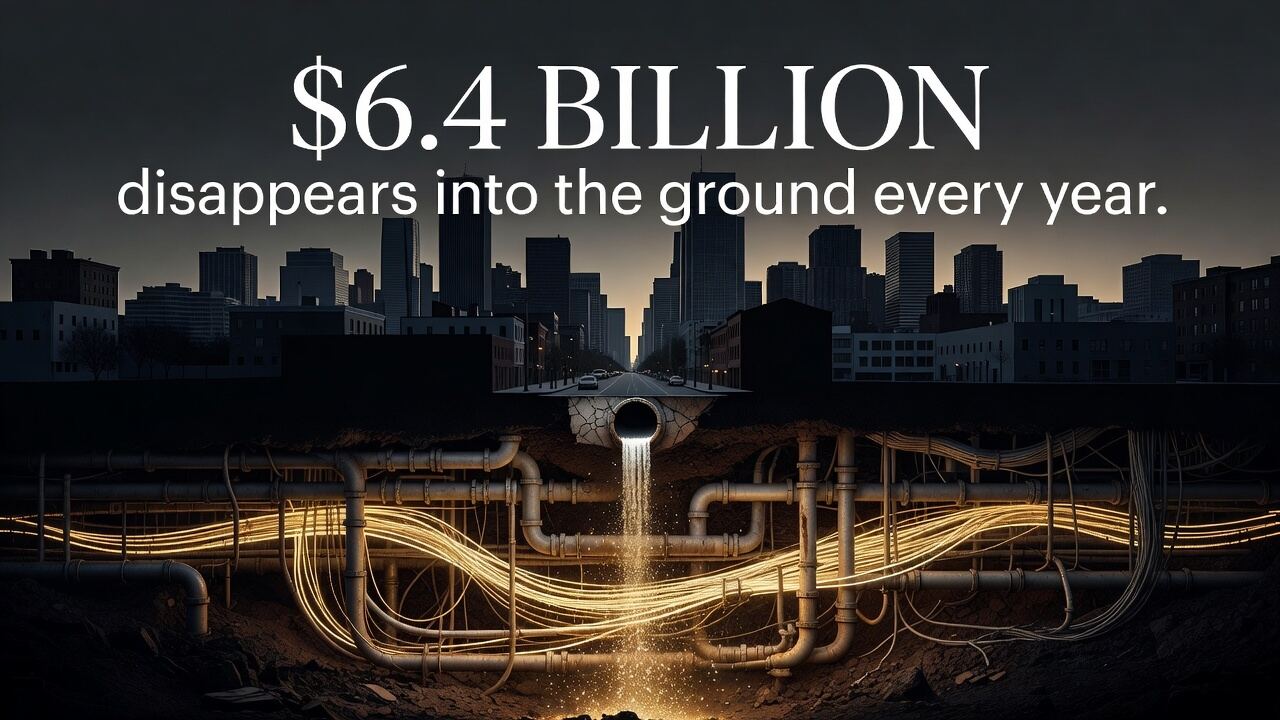
Cutaway illustration of a city street revealing a glowing map of buried pipes and cables, with $6.4 billion in water losses highlighted.

$6.4 billion of treated drinking water disappears into the ground every year.

The fix isn't better pipes. It's knowing where the pipes are.

America is rebuilding its infrastructure on top of a map that doesn't exist. Nobody knows exactly what's buried under our streets. Pipes from 1920, cables from 1970, conduit someone forgot to record in 1995. So before every dig, a technician walks the site with a handheld wand and marks the ground in spray paint. The paint washes away. Next month, someone walks the same street and does it again. The same pipe gets located hundreds of times and known zero times.

Meanwhile, on giant transit and rail projects, this problem is largely solved. Multi-sensor rigs sweep a corridor and AI reads the sensor data the way a radiologist reads a scan, fusing it into a 3D picture of everything underground. It works. It's deployed. And it's mostly staying locked inside megaprojects.

The interesting question is never "does the technology work." It's "where is it worth the most, and why isn't it there yet?"

Back to that opening number, because it deserves to be unpacked. That $6.4 billion is one in five gallons — 19.5% of all treated drinking water in the US, about 6.75 billion gallons a day, pumped, treated, pressurized, and then gone before it reaches a customer. And a water main breaks somewhere in America every two minutes.

Now give that utility a real map of its own system, and watch what it can do:

Go find the leaks while they're small, instead of waiting for 240,000 mains a year to announce themselves by flooding a street. Lost water isn't a labor problem. It's product walking out the door, and the map is how you get it back.

Replace the pipe that's about to fail instead of the pipe that's merely old. An emergency break means overtime crews, road closures, boil-water notices. A planned replacement is a Tuesday. Same budget, far more risk retired.

Dig once. Every city knows the absurdity: repave a street, then cut it open six months later for a water line, then again for fiber. With a shared underground map, paving, water, broadband, and electric work get sequenced into one opening. A GAO analysis put coordination savings at up to 33% in urban areas. That's not a utility win. That's a whole-city win.

And here's the part I find most interesting: projects that don't happen today start to pencil. Undergrounding power lines for wildfire risk. Fiber to smaller towns. A huge share of the cost of any of these is uncertainty about what's already down there. Make certainty cheap and marginal projects clear the hurdle. That's new construction, not redistributed construction.

Which answers the jobs question. This isn't automation taking work away. Construction needed 439,000 new workers last year and half the skilled workforce retires within a decade. There aren't too many workers in this world; there are too few. The wand-and-paint technician becomes a sensor-rig operator and field data validator, a more skilled, better-paid job. And the map itself creates permanent new work, because a map starts decaying the day someone installs something new. Keeping it alive is a function that doesn't exist today: field capture, data validation, the people inside utilities and cities who turn it into decisions.

Construction and geotech have their own versions of this chain. In geotech, the survey getting cheaper is the boring part. The interesting part is what a firm owns after 200 projects done this way. I'll leave that one there.

The pattern underneath all of it: these industries treat underground knowledge as a cost paid per event. Per ticket, per dig, per project. Pay it, use it once, let it evaporate. The unlock is that the knowledge starts compounding instead of evaporating. Somewhere in that shift, a higher-value business emerges inside the existing one.

What was missing was discovery: someone looking at an industry from the outside and asking where growth is hiding in plain sight. Every business has unlocked innovation that can compound their current business. The companies that find theirs first don't work harder than everyone else. They just looked.

That's what we do at pilottopayoff.com. Discovery first: five well-researched ideas for where your business can grow, each one worked out the way this post worked out water. Then, if you want help making one real, implementation. But it starts with the looking.

What's buried under your business?

Discovery first. Five well-researched ideas for where your business can grow.

Get started

    The Map That Doesn't Exist

    Why $6.4 Billion Disappears Into the Ground Every Year

    2026-07-29

    $6.4 billion of treated drinking water disappears into the ground every year.

    The fix isn't better pipes. It's knowing where the pipes are.

    America is rebuilding its infrastructure on top of a map that doesn't exist. Nobody knows exactly what's buried under our streets. Pipes from 1920, cables from 1970, conduit someone forgot to record in 1995. So before every dig, a technician walks the site with a handheld wand and marks the ground in spray paint. The paint washes away. Next month, someone walks the same street and does it again. The same pipe gets located hundreds of times and known zero times.

    Meanwhile, on giant transit and rail projects, this problem is largely solved. Multi-sensor rigs sweep a corridor and AI reads the sensor data the way a radiologist reads a scan, fusing it into a 3D picture of everything underground. It works. It's deployed. And it's mostly staying locked inside megaprojects.

    The interesting question is never "does the technology work." It's "where is it worth the most, and why isn't it there yet?"

    Back to that opening number, because it deserves to be unpacked. That $6.4 billion is one in five gallons — 19.5% of all treated drinking water in the US, about 6.75 billion gallons a day, pumped, treated, pressurized, and then gone before it reaches a customer. And a water main breaks somewhere in America every two minutes.

    Now give that utility a real map of its own system, and watch what it can do:

    Go find the leaks while they're small, instead of waiting for 240,000 mains a year to announce themselves by flooding a street. Lost water isn't a labor problem. It's product walking out the door, and the map is how you get it back.

    Replace the pipe that's about to fail instead of the pipe that's merely old. An emergency break means overtime crews, road closures, boil-water notices. A planned replacement is a Tuesday. Same budget, far more risk retired.

    Dig once. Every city knows the absurdity: repave a street, then cut it open six months later for a water line, then again for fiber. With a shared underground map, paving, water, broadband, and electric work get sequenced into one opening. A GAO analysis put coordination savings at up to 33% in urban areas. That's not a utility win. That's a whole-city win.

    And here's the part I find most interesting: projects that don't happen today start to pencil. Undergrounding power lines for wildfire risk. Fiber to smaller towns. A huge share of the cost of any of these is uncertainty about what's already down there. Make certainty cheap and marginal projects clear the hurdle. That's new construction, not redistributed construction.

    Which answers the jobs question. This isn't automation taking work away. Construction needed 439,000 new workers last year and half the skilled workforce retires within a decade. There aren't too many workers in this world; there are too few. The wand-and-paint technician becomes a sensor-rig operator and field data validator, a more skilled, better-paid job. And the map itself creates permanent new work, because a map starts decaying the day someone installs something new. Keeping it alive is a function that doesn't exist today: field capture, data validation, the people inside utilities and cities who turn it into decisions.

    Construction and geotech have their own versions of this chain. In geotech, the survey getting cheaper is the boring part. The interesting part is what a firm owns after 200 projects done this way. I'll leave that one there.

    The pattern underneath all of it: these industries treat underground knowledge as a cost paid per event. Per ticket, per dig, per project. Pay it, use it once, let it evaporate. The unlock is that the knowledge starts compounding instead of evaporating. Somewhere in that shift, a higher-value business emerges inside the existing one.

    What was missing was discovery: someone looking at an industry from the outside and asking where growth is hiding in plain sight. Every business has unlocked innovation that can compound their current business. The companies that find theirs first don't work harder than everyone else. They just looked.

    That's what we do at pilottopayoff.com. Discovery first: five well-researched ideas for where your business can grow, each one worked out the way this post worked out water. Then, if you want help making one real, implementation. But it starts with the looking.

    What's buried under your business?

    Discovery first. Five well-researched ideas for where your business can grow. Get started